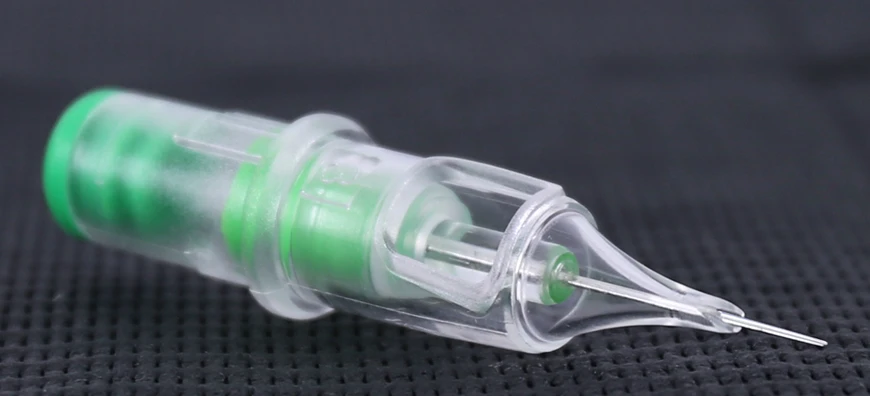
Tattoo needles come in many different sizes, each size is meant for a particular purpose. Each tattoo needle is a collection of several smaller needles and each of these small needles has a specific diameter.
The number of small needles and the diameter of those determine the size of a tattoo needle. The standard diameter for a liner needle is 12 gauge, however, it can also be smaller such as 10 gauge or 8 gauge.
Each tattoo needle contains several needles, it can be 1 needle, or 3 or 5, or even 13, however, it is always an odd number of needles. These needles are placed in a circular arrangement to create a needle tip that resembles a paintbrush.
You can consider each small needle as a strand of a paintbrush that meets together to form a fine tip. The thickness of this tip determines the actual line that will be tattooed on the skin.
For example, if you have a needle which is 12 01 RL, it consists of a single needle which is of the size 12 gauge, but if you have a 08 03 Rl, it means it is a collection of three needles, each of which is 8 gauge in size. These needles will create different types of lines and so they need to be used for different purposes.
2. Tattooing technique
Which needle you choose for your linework depends highly upon which technique you use. For a thin line, it may not require much effort however for a thicker line you can employ several techniques – lining and filling, multiple stacked lines, or round shader technique.
Lining and filling mean that you outline the thick line with a thin needle and then use a thicker needle to fill in the gaps. Multiple stacked lines mean that you use the same needle to repeatedly draw thin lines next to each other until the desired thickness is achieved.
The round shader technique means using a thick round shader needle instead of a lining needle to complete the work. All of these methods are effective and depending upon your preference you may want to choose one particular needle or multiple needles to complete your work.
3. Taper
The tip of the tattoo needle has a specific taper to it, and this is an important measurement to consider while choosing a liner needle. The longer the taper of a needle, the more control it has on ink flow.
This means that a needle with a short taper will have more ink flow than a needle with a long or extra long taper. The amount of ink flow determines the saturation of the lines so, in other words, a needle with a long taper will have a less saturated grey line while a needle with a short taper will have a highly saturated dark line. For linework, a needle with a short taper is always preferred.
4. Fine lines
We have mentioned before that a thick line can be achieved through several different techniques. However, if you are trying to achieve a fine or thin line, the techniques are very different. If you want to achieve a very fine line, the best option is to use a single needle.
Single needle liners are great for achieving details such as in realism portraits or miniature tattoos. These types of tattoos require a high level of precision without the boldness of a typical liner needle. The most common types of single needles are 12 01 RL, and 10 01 RL.
5. Precision
Liner needles need to be very precise and they need to have a very sharp tip. If the needles are not sharp or precise enough then the line may not be as sharp as desired. This is why it is always important to look for the best quality needles for lining work.
Final Words:
As a tattoo apprentice, one of the first things you learn is lines, it is the basic to every tattoo and without learning how to line it is impossible to finish any tattoo. To be able to make a good line in tattoos, you definitely need a good lining needle, and so you can choose from our Spark best lining needles to meet your needs. Always choose the needle according to the work you are doing, for example, if you need to make a detailed line, do not use thick needles, always use thin needles for that purpose.